So, I earlier wrote a post about how they want to try hackers under organised crime laws. Well, I must admit, must to my chagrin, that I may have overlooked some details. Well, not so much details as scenarios and/or types of attackers. My previous post focused primarily on the "breaking and entering" breed of hacker, specifically the kind without any financial motivations. There in, lies my folly.
The attacker I described was the kind that will break a system, to quote the famed LulzSec group, "just for lulz," or with some form of activist agenda, a la Operation Payback. Here the attacker(s) main objective was to point out a weakness in a system, cripple a system as a form of protest, or simply to entertain themselves. Well, in any case, here the idea of organised crime does fall a tad flat, as explained previously.
Now, we move to something a colleague pointed out to me today. If we consider fiscally motivated crimes, then we begin to see the motivation for this kind of approach. Consider the case of identity theft via phishing, for argument's sake. Although this kind of attack can be done alone, there is essentially a mafia that controls large parts of this trade. It is very reminiscent of the classical mobsters, to the extent that there is large speculation of them being linked. Of course I know no knowledge beyond the rumblings of their existance, but I am convinced.
Although there are other, and arguably more sophisticated, ways of committing digital identity fraud, they all do have the same mafia-esque touch to them. Here, the idea of treating these in the same manner as organised crime is not a far fetched idea at all. In fact, I believe it is the right idea.
So, in summary, this idea is not all bad and in fact is very good for certain classes of digital criminals, but not so much for others. Hopefully, the law all over will catch up to all the crazy types of security threats in our crazy world.
Wednesday, 14 September 2011


Monday, 12 September 2011
Hackers = Mobsters?
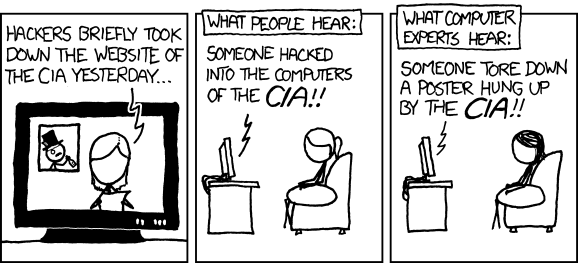
Ok, so as promised: post number 2 of today (just to be pedantic, my today). So, I recently read this in which President Obama said that he wants hackers will be treated, for the purposes of the law, in a manner similar to that of organised crime. Yes, people, that means mobsters, as in Tony Montana or Al Capone. That does make hackers sound so much cooler now that we are imagining them in pinstripe suits and not nerdy T-Shirts, but we must question the validity of this.
My main objection to this is the term "organized", not only due to the fact that I prefer British spelling, but mainly because, it's not always true. Yes, one could say that LulzSec is/was somewhat akin to the famed "Cosa Nostra," but they do indeed prove to be the exception to the rule. The next closest thing is Anonymous, but they are at best a loose collection of similar-ish minded individuals, who got together for one job and then disbanded. Of course some members will carry out attacks in unison after that, but it would almost certainly not be the whole group again.
Further more, there is a somewhat implicit assumption of some form of heirarchy amongst hackers. There may well be "senior" and "junior" member of the group and there may well be some people with more influence or more authority, but no really chain of command, so to speak. To the best of my knowledge there is no Godfather in hacker communities. So, here again the organised argument breaks down.
Of course, the previous is in the case where there is actually more than one person involved. It is neither impossible nor uncommon, for a single hacker to mounts attacks on a fairly large scale. Yes, I know that the article states that "complex and sophisticated electronic crimes are rarely perpetrated by a lone individual," but there have been reports of single attackers mounted somewhat complex attacks. Granted, they may have obtained resources from other individuals/groups, but they did mainly act alone. In the case of this single perpetrator, the term organised seems to be a dash irrelevant. I can imagine that the lawmen would be well pressed to somehow fits such a scenario into these laws.
Furthermore one would assume that the Racketeer Influenced and Corrupt Organizations (RICO) Act would be the basis for this new version of the Computer Fraud and Abuse Act (CFAA). I am not a legal expert, but I can imagine that this would be quite challenging. You see, these two classes of criminals live and operate in very different environments, thus making any sort of an analogy difficult. However, this idea is not without merit.
Recently, this story emerged. An Australian blogger wrote about domain-name fraud and found himself in a spot of bother. He was, and still is from what I gather, being DDoSed. The thing is that the log files show the traffic coming from non-existent websites, which are actually death threats to him. One example is “http://lastwarning-shutdown-yourblog-or-die-withyourparklogic.com”. This does seem to be very much like old school mafia behaviour, which lends great credence to this new idea.
So, although it may not be IMHO the best way to go about, it is not without its merits. As this develops further, it may even become an excellent law. Until, all we can do is wait and see.
My main objection to this is the term "organized", not only due to the fact that I prefer British spelling, but mainly because, it's not always true. Yes, one could say that LulzSec is/was somewhat akin to the famed "Cosa Nostra," but they do indeed prove to be the exception to the rule. The next closest thing is Anonymous, but they are at best a loose collection of similar-ish minded individuals, who got together for one job and then disbanded. Of course some members will carry out attacks in unison after that, but it would almost certainly not be the whole group again.
Further more, there is a somewhat implicit assumption of some form of heirarchy amongst hackers. There may well be "senior" and "junior" member of the group and there may well be some people with more influence or more authority, but no really chain of command, so to speak. To the best of my knowledge there is no Godfather in hacker communities. So, here again the organised argument breaks down.
Of course, the previous is in the case where there is actually more than one person involved. It is neither impossible nor uncommon, for a single hacker to mounts attacks on a fairly large scale. Yes, I know that the article states that "complex and sophisticated electronic crimes are rarely perpetrated by a lone individual," but there have been reports of single attackers mounted somewhat complex attacks. Granted, they may have obtained resources from other individuals/groups, but they did mainly act alone. In the case of this single perpetrator, the term organised seems to be a dash irrelevant. I can imagine that the lawmen would be well pressed to somehow fits such a scenario into these laws.
Furthermore one would assume that the Racketeer Influenced and Corrupt Organizations (RICO) Act would be the basis for this new version of the Computer Fraud and Abuse Act (CFAA). I am not a legal expert, but I can imagine that this would be quite challenging. You see, these two classes of criminals live and operate in very different environments, thus making any sort of an analogy difficult. However, this idea is not without merit.
Recently, this story emerged. An Australian blogger wrote about domain-name fraud and found himself in a spot of bother. He was, and still is from what I gather, being DDoSed. The thing is that the log files show the traffic coming from non-existent websites, which are actually death threats to him. One example is “http://lastwarning-shutdown-yourblog-or-die-withyourparklogic.com”. This does seem to be very much like old school mafia behaviour, which lends great credence to this new idea.
So, although it may not be IMHO the best way to go about, it is not without its merits. As this develops further, it may even become an excellent law. Until, all we can do is wait and see.
Sunday, 11 September 2011
(Distributed) Denial of Service attacks, intentional or otherwise.
So, I have been away for a bit and thus the lack of posting. So to make that up, there will be two posts today and at least one more this week. Right, lets get into its shall we? Today's topic is (Distributed) Denial of Service attacks and how they can be inadvertently caused. So, first off, what exactly is is a Denial of Service (DoS) and indeed a Distributed Denial of Service (DDoS) attack.
A Denial of Service (DoS) attack involves sending an excessive amounts of data/requests/pings to a server with the aim of overloading the server so that legitimate users can not access the server. Imagine the following scenario: there is an office with an information counter. Normally, people would walk up tot he counter, get the information they need and then leave. After this the next person does the same and so on and so forth. A DoS would essentially be one person standing at the counter and asking so many questions that nobody else can get up to the counter.
A Distributed DoS (DDoS) is the same thing, except with one minor difference. In a standard DoS, there is only one attacker and one attacking system. In a DDoS, there may still be one attacker, but there are several systems that involved in the attack. For all intents and purposes, DoS attacks really only exist in textbooks, so we will only consider DDoS attacks.
So, now that we know what DDoS attacks are, let's look at how they happen. The normal scenario is that our attacker(s) pick a target and then bombard them with request. At a technical level, there are several ways to this in an intelligent ways, but the simplest is just overwhelming the server with requests. I would rather not get into the details, because to be quite honest, I find them inane and boring. SO, let's just say there are many ways of doing it.
Now, if you recall I did say we were going to discuss how one may inadvertently perform a DDoS. First off, we need to realise that different websites require different levels of hardware. Right at the top you have the likes of Google, who require server farms of sizes that are difficult to fathom. Then you go down to the bottom, where you have tiny websites that get a couple of hits a week, which probably run on a single machine. Obviously, the smaller the server, the easier it is to DDoS.Now, the unintentional DDoS attacks happen to theses smaller sites. How you ask? Well simple, they get very popular, very fast.
There a few ways you can achieve this. Firstly, start off a small website and then becomes popular. Then when you post new content, number of people accessing your site goes through the roof and your site becomes temporarily unavailable. Don't think this is possible? I refer you to a delightful webcomic (in a manner of speaking) The Oatmeal, run by Matthew Inman. He even says something about it on his Facebook page. He does somewhat DDoS himself, by being awesome!
Another way is best explained by using Stephen Fry as an example. Stephen had built up quite a fan base as an entertainer and television personality over the years, so when he ended up in Twitter, well naturally he had a smattering of followers (myself included). He is quite an avid user and apart from the usual tweets of his current activities (and of course his tweets for charity), he does tweet links to amusing content from time to time. The moment that tweet hits the net, there are thousands of people clicking that link and well it has caused more that one site to go down.
As we can see in both cases, neither party had any malicious intent towards the sites that they inadvertently DDoS'ed, but it did happen. The unfortunate part of this is that there is no way to defend against it. Well, there is the no practical way to defend against it. Of course, everybody could use industrial size server farms, but that is not really practical. There may be some sort of gains made if everything was hosted in the cloud, but I'm not sure how feasible that is.
A Denial of Service (DoS) attack involves sending an excessive amounts of data/requests/pings to a server with the aim of overloading the server so that legitimate users can not access the server. Imagine the following scenario: there is an office with an information counter. Normally, people would walk up tot he counter, get the information they need and then leave. After this the next person does the same and so on and so forth. A DoS would essentially be one person standing at the counter and asking so many questions that nobody else can get up to the counter.
A Distributed DoS (DDoS) is the same thing, except with one minor difference. In a standard DoS, there is only one attacker and one attacking system. In a DDoS, there may still be one attacker, but there are several systems that involved in the attack. For all intents and purposes, DoS attacks really only exist in textbooks, so we will only consider DDoS attacks.
So, now that we know what DDoS attacks are, let's look at how they happen. The normal scenario is that our attacker(s) pick a target and then bombard them with request. At a technical level, there are several ways to this in an intelligent ways, but the simplest is just overwhelming the server with requests. I would rather not get into the details, because to be quite honest, I find them inane and boring. SO, let's just say there are many ways of doing it.
Now, if you recall I did say we were going to discuss how one may inadvertently perform a DDoS. First off, we need to realise that different websites require different levels of hardware. Right at the top you have the likes of Google, who require server farms of sizes that are difficult to fathom. Then you go down to the bottom, where you have tiny websites that get a couple of hits a week, which probably run on a single machine. Obviously, the smaller the server, the easier it is to DDoS.Now, the unintentional DDoS attacks happen to theses smaller sites. How you ask? Well simple, they get very popular, very fast.
There a few ways you can achieve this. Firstly, start off a small website and then becomes popular. Then when you post new content, number of people accessing your site goes through the roof and your site becomes temporarily unavailable. Don't think this is possible? I refer you to a delightful webcomic (in a manner of speaking) The Oatmeal, run by Matthew Inman. He even says something about it on his Facebook page. He does somewhat DDoS himself, by being awesome!
Another way is best explained by using Stephen Fry as an example. Stephen had built up quite a fan base as an entertainer and television personality over the years, so when he ended up in Twitter, well naturally he had a smattering of followers (myself included). He is quite an avid user and apart from the usual tweets of his current activities (and of course his tweets for charity), he does tweet links to amusing content from time to time. The moment that tweet hits the net, there are thousands of people clicking that link and well it has caused more that one site to go down.
As we can see in both cases, neither party had any malicious intent towards the sites that they inadvertently DDoS'ed, but it did happen. The unfortunate part of this is that there is no way to defend against it. Well, there is the no practical way to defend against it. Of course, everybody could use industrial size server farms, but that is not really practical. There may be some sort of gains made if everything was hosted in the cloud, but I'm not sure how feasible that is.
Thursday, 18 August 2011
rankmyhack.com - WHY?
So, recently it has come to my attention that there is a website called rankmyhack.com [twitter account] (at last attempt the site was unreachable and isup.me said it looks down) which basically encourages the general populous to hack stuff, post details of it and get points based on how good it was. So, something simple like logging into a system where they left the guest account open would score minimal points, but a more complex exploit, such as say a SQL injection, would score more. Sounds fun right?
WRONG! I for one will tell how important it is to secure your web-facing interfaces, devices and any combination thereof till the cows come home, but there is a proper way to do that. There are some standard known practices and counter-measures against exploits that you can put in place. Of course this process is fairly mechanical and does not account for human ingenuity.
Tiger Teams (that term always makes me think of this), enter stage left. Now a Tiger Team or Red Team is a bunch of inhouse or outsourced hackers whose sole job is to attack the system. They do this in a contained environment and report all the exploits the the developers who then correct any flaws. Ideally, they will find everything, but there is no guarantee of that. If they are good, they will find most of them.
That's the normal way of doing it. This site however basically sets the dogs loose on every single person on the Internet. You, my dear beloved reader are at risk. If you are reading this, it is a safe assumption that you have access to the Internet. A further safe assumption is that you have at least one e-mail account. BOOM! Target numero uno. But it gets better. Do you have: Facebook? Twitter? Social media sites? Other sites? Your own website? Smartphone? All targets. There are a plethora more and I will not list them all but you get the idea.
The very idea that a website would be dedicated to this kind of malicious and illegal behaviour is utterly beyond me. Why don't we have a website dedicated to videos of us crashing our cars into walls and rate those? ratemycrash.com! Brilliant idea! And as I typed that, I realised that it probably exists, which it does. When I saw that page, my soul died a little bit. But I digress.
This website is the digital equivalent of a bunch of mobsters gathered around a dinner table bragging about all the crimes they have committed. Yes, I know I have shown a little bit of annoyance at the Black Hat conferences and the like, but in the end it is serious security research. I know they sexy it up and throw in a bit of FUD but at the end of the day it is valid research with some useful insights and is helpful in the design of future systems.
This site, not so much. It also helps further perpetuate the whole image of hackers portrayed in the media. You may remember my previous comment about the green on black terminals. Yeah, that's all there. There are times when people do things which we don't agree on and we move on. Then there are times when people do things and it just about turns you into a misanthrope. This isn't one of the latter, but it sure as hell ain't helping!
WRONG! I for one will tell how important it is to secure your web-facing interfaces, devices and any combination thereof till the cows come home, but there is a proper way to do that. There are some standard known practices and counter-measures against exploits that you can put in place. Of course this process is fairly mechanical and does not account for human ingenuity.
Tiger Teams (that term always makes me think of this), enter stage left. Now a Tiger Team or Red Team is a bunch of inhouse or outsourced hackers whose sole job is to attack the system. They do this in a contained environment and report all the exploits the the developers who then correct any flaws. Ideally, they will find everything, but there is no guarantee of that. If they are good, they will find most of them.
That's the normal way of doing it. This site however basically sets the dogs loose on every single person on the Internet. You, my dear beloved reader are at risk. If you are reading this, it is a safe assumption that you have access to the Internet. A further safe assumption is that you have at least one e-mail account. BOOM! Target numero uno. But it gets better. Do you have: Facebook? Twitter? Social media sites? Other sites? Your own website? Smartphone? All targets. There are a plethora more and I will not list them all but you get the idea.
The very idea that a website would be dedicated to this kind of malicious and illegal behaviour is utterly beyond me. Why don't we have a website dedicated to videos of us crashing our cars into walls and rate those? ratemycrash.com! Brilliant idea! And as I typed that, I realised that it probably exists, which it does. When I saw that page, my soul died a little bit. But I digress.
This website is the digital equivalent of a bunch of mobsters gathered around a dinner table bragging about all the crimes they have committed. Yes, I know I have shown a little bit of annoyance at the Black Hat conferences and the like, but in the end it is serious security research. I know they sexy it up and throw in a bit of FUD but at the end of the day it is valid research with some useful insights and is helpful in the design of future systems.
This site, not so much. It also helps further perpetuate the whole image of hackers portrayed in the media. You may remember my previous comment about the green on black terminals. Yeah, that's all there. There are times when people do things which we don't agree on and we move on. Then there are times when people do things and it just about turns you into a misanthrope. This isn't one of the latter, but it sure as hell ain't helping!
Sunday, 14 August 2011
Black Hat and the constant accompyning headlines!
So, recently there was the Black Hat conference in Vegas. For those of you who are less informed, this is basically a large gathering of security researchers presenting their latest findings. And by findings I mean what they have recently broken. Most people dub this a "hacker" conference which is not to unreasonable, but I have one issue with it. The media coverage of it.
The only reason the term "hacker" is used is to sound sexy to the media. They hear that word and they are doing backflips through rings of fire to get the story. And as we are aware the media doesn't always get it right when reporting computer security related issues. Black hat presentations are geared to getting the media attention and causing a bit of a frenzy.
A prime example of that is Don Bailey's presentation which was entitled "War Texting: Identifying and Interacting with Devices on the Telephone Network" which does raise some valid points about connectivity of critical devices (details in another post) but it was also well marketed. He showed that he could unlock cars just by sending a few text messages. When normal people hear something like "vulnerability in FPGA-based control systems" or something similar they do not really know what it means.
Say "I can unlock your car with my phone" and they are scared. Don did say (quote in this article) "I could care less if I could unlock a car door. It's cool. It's sexy. But the same system is used to control phone, power, traffic systems. I think that's the real threat." Which is basically my grievance. As security researchers, we have to sexy up our ideas and then present them to the general populous. Which in turn leads to what I would deem to be an inconvenience.
If you want media attention, then you research on topics that you can sell with a little bit of FUD. Which does restrict your scope quite a lot. This then has a further effect that people view security researchers as only doing this kind of research. This leaves the more theoretical people, like myself, out in the cold, so to speak. Which may or may not be a bad thing, I am not really sure, but I am very sure that it does grind my gears a smidge.
The only reason the term "hacker" is used is to sound sexy to the media. They hear that word and they are doing backflips through rings of fire to get the story. And as we are aware the media doesn't always get it right when reporting computer security related issues. Black hat presentations are geared to getting the media attention and causing a bit of a frenzy.
A prime example of that is Don Bailey's presentation which was entitled "War Texting: Identifying and Interacting with Devices on the Telephone Network" which does raise some valid points about connectivity of critical devices (details in another post) but it was also well marketed. He showed that he could unlock cars just by sending a few text messages. When normal people hear something like "vulnerability in FPGA-based control systems" or something similar they do not really know what it means.
Say "I can unlock your car with my phone" and they are scared. Don did say (quote in this article) "I could care less if I could unlock a car door. It's cool. It's sexy. But the same system is used to control phone, power, traffic systems. I think that's the real threat." Which is basically my grievance. As security researchers, we have to sexy up our ideas and then present them to the general populous. Which in turn leads to what I would deem to be an inconvenience.
If you want media attention, then you research on topics that you can sell with a little bit of FUD. Which does restrict your scope quite a lot. This then has a further effect that people view security researchers as only doing this kind of research. This leaves the more theoretical people, like myself, out in the cold, so to speak. Which may or may not be a bad thing, I am not really sure, but I am very sure that it does grind my gears a smidge.
Wednesday, 27 July 2011
Security the MS way: Protecting you from yourself!
I have always maintained that Microsoft's security policy is essentially to stop you from doing anything stupid. The concept in itself is fairly sound, but the implementation is not. In the classic Operating System debate of Windows versus Linux, the biggest point Linux users make is that they can modify any part of the operating system to suit their needs and desires. When I used Windows XP, I had found all the little secrets to get my machine to do what I wanted it to do. But, I digress.
Microsoft basically adopted the "protect the users from themselves" approach in earnest in Windows Vista. There are several reason why I (and others) am not too fond of Vista, but that aside. The idea is sound in theory, but the implemenatation of it left so much to be desired. In hiding all the knifes from the kids, they also hid all the forks and spoons. Yes, I agree that some of the functionalities should not be available to normal users, but it should be available to admin users.
A whole plethora of useful features were hidden, but we shan't go into that now. The main thing is this article. Now I know I'm a bit late to jump onto this, but I have been a tad lazy. Moving on. So it seems that Hotmail will ban common and quite frankly shit passwords. This is a good and a bad thing.
As I have pointed out before, passwords can be tricky things. For something iek your e-mail account, you need a decent password. So now if Hotmail will reject your password because it's shit, that good right? Well, yes and no. It does stop dictionary attacks, however it drastically changes the search space.
Previously, an attacker would run dictionary attacks in the hope that somebody was a fool. Now that cannot happen then the system is foolproof right? Yes, but to quote Douglas Adams "A common mistake that people make when trying to design something completely foolproof is to underestimate the ingenuity of complete fools." It may sound a touch misanthropic, but people are stupid.
Eventually what is going to happen is that people will find that people will find the least complex passwords that pass through the Hotmail filter and then use those passwords repeatedly. Now dictionary based attacks kick in again, just with a new dictionary. The dictionaries may be larger than previously, but it may not be a significant amount.
So, it is a good idea and I am very much in favour of this, but it could also backfire. Only time will tell, we shall wait and see.
Microsoft basically adopted the "protect the users from themselves" approach in earnest in Windows Vista. There are several reason why I (and others) am not too fond of Vista, but that aside. The idea is sound in theory, but the implemenatation of it left so much to be desired. In hiding all the knifes from the kids, they also hid all the forks and spoons. Yes, I agree that some of the functionalities should not be available to normal users, but it should be available to admin users.
A whole plethora of useful features were hidden, but we shan't go into that now. The main thing is this article. Now I know I'm a bit late to jump onto this, but I have been a tad lazy. Moving on. So it seems that Hotmail will ban common and quite frankly shit passwords. This is a good and a bad thing.
As I have pointed out before, passwords can be tricky things. For something iek your e-mail account, you need a decent password. So now if Hotmail will reject your password because it's shit, that good right? Well, yes and no. It does stop dictionary attacks, however it drastically changes the search space.
Previously, an attacker would run dictionary attacks in the hope that somebody was a fool. Now that cannot happen then the system is foolproof right? Yes, but to quote Douglas Adams "A common mistake that people make when trying to design something completely foolproof is to underestimate the ingenuity of complete fools." It may sound a touch misanthropic, but people are stupid.
Eventually what is going to happen is that people will find that people will find the least complex passwords that pass through the Hotmail filter and then use those passwords repeatedly. Now dictionary based attacks kick in again, just with a new dictionary. The dictionaries may be larger than previously, but it may not be a significant amount.
So, it is a good idea and I am very much in favour of this, but it could also backfire. Only time will tell, we shall wait and see.
Wednesday, 29 June 2011
FIFTY!!! YAAAYY!!!
So, this is my 50th post. WOOHOOO!!! Enough with the celebrations, we have work to do. I decided to mark this momentous milestone, I will discuss the basics of cryptography. Now, I know I have covered some bits of this before, feel free to skip any parts you think you know. So, let's start by naming the three principle components of cryptography : Encryption, Signatures/Message Authentication Codes(MACs) and Proofs.
So, let's start with the first, and probably most well-known, section: Encryption. The scenario is simple, you have a message that you wish to communicate to somebody else, without anybody else finding out that message. The way to do this is encryption. Think back to when you were a kid and you and your friends made up a secret language. That could be viewed as a crude form of encryption, as can all languages. But now, lets talk about the more modern stuff.
An encryption scheme is basically two functions: and encryption function, which I will denote by ENC, and a decryption function, which I will denote by DEC. ENC takes a normal message and turns it into something unintelligible, called a ciphertext. DEC takes a ciphertext and turns it back into the message. To do this, both functions need some additional information, called a key. There are two flavours of encryption, both defined by the relation between the keys used by ENC and DEC. In symmetric or secret key encryption, both ENC and DEC use the same key, whereas in asymmetric or public key encryption, they use distinct but related keys.
Now you must be wondering where all these keys come from and how they get to the right people. For the asymmetric setting it's fairly simple. The receiver generates the keys and publishes the public encryption key, PK, and keeps the decryption key, SK, secret. The publication of PK leads to some very interesting problems, but that's out of scope, but worth mentioning. In the symmetric setting, it's a tad more complicated and this problem is a whole research area on it's own. Let's just say that there are clever ways of doing it in several circumstances.
Now signatures/MACs are essentially the same thing, with different key settings. MAC use symmetric keys and signatures use asymmetric keys. They both serve the same purpose, that is to authenticate the source of a message. For simplicity, I will refer to both of them as codes, which is an abuse of many notations, but will suffice for our purposes. All code systems have two functions: generate, denoted GEN, and verify, denoted VER, and they work as follows: generate takes in a message and outputs a tag and verify takes in a message and a tag and checks if the tag was indeed generated by the sender for that message.
Here we must note two very important things. Tags are both sender and message dependant. Thus a valid tag for one message, cannot be a valid tag for another message sent by the same person. Also, a valid tag for a message sent by one person cannot be a valid tag for the same message sent by another person. Thus the VER functions takes as input the message and the identity of the person, implicitly in the key. The main assumption here is that only the sender can generate a valid tag and thus any valid tag implies that the message was sent by them. This is very close to real world signatures and how we view them. Yes, I know that real signatures can be forged, but we also consider that in cryptography. There are some subtleties as to how this is done, but we shan't venture into that.
Finally, we come upon proofs. These are the least well-known and some would say the least understood of the three. The basic idea behind a proof system is that one party wants to prove to the other that a secret value x has some property. The property could be proven by revealing x, but then that would defeat the point of it being secret. So you need to somehow show that x has this property, but without revealing x. We seem to be in a bit f a pickle. That is, until our hero zero knowledge proofs show. These are protocols which allow you to prove certain statements about a value(s) without revealing the value and without the other person learning anything about the secret value.
A simple way to view this is by the simple statement: "Pick a card, any card!" Let's say I hand you a deck of cards and you pick one out at random and put it aside. Now I ask you what suit it is. You tell me it's a spade. I ask you to prove it. You could show me your card, but that's a secret right? Well, how about you show me 13 clubs, 13 hearts and 13 diamonds. *DING*! Now I know nothing more about your card than that it is in fact a spade. This example is great when explaining not only zero knowledge proofs, but also some of it's stranger variants. But that's all for later (read: maybe if I feel like, but don't hold your breath).
So, all in all, we covered the three basic concepts in cryptography because I'm too lazy to do real posts and the number 50 was just mainly an excuse. We hope to have a resumption of normal service soon-ish.
So, let's start with the first, and probably most well-known, section: Encryption. The scenario is simple, you have a message that you wish to communicate to somebody else, without anybody else finding out that message. The way to do this is encryption. Think back to when you were a kid and you and your friends made up a secret language. That could be viewed as a crude form of encryption, as can all languages. But now, lets talk about the more modern stuff.
An encryption scheme is basically two functions: and encryption function, which I will denote by ENC, and a decryption function, which I will denote by DEC. ENC takes a normal message and turns it into something unintelligible, called a ciphertext. DEC takes a ciphertext and turns it back into the message. To do this, both functions need some additional information, called a key. There are two flavours of encryption, both defined by the relation between the keys used by ENC and DEC. In symmetric or secret key encryption, both ENC and DEC use the same key, whereas in asymmetric or public key encryption, they use distinct but related keys.
Now you must be wondering where all these keys come from and how they get to the right people. For the asymmetric setting it's fairly simple. The receiver generates the keys and publishes the public encryption key, PK, and keeps the decryption key, SK, secret. The publication of PK leads to some very interesting problems, but that's out of scope, but worth mentioning. In the symmetric setting, it's a tad more complicated and this problem is a whole research area on it's own. Let's just say that there are clever ways of doing it in several circumstances.
Now signatures/MACs are essentially the same thing, with different key settings. MAC use symmetric keys and signatures use asymmetric keys. They both serve the same purpose, that is to authenticate the source of a message. For simplicity, I will refer to both of them as codes, which is an abuse of many notations, but will suffice for our purposes. All code systems have two functions: generate, denoted GEN, and verify, denoted VER, and they work as follows: generate takes in a message and outputs a tag and verify takes in a message and a tag and checks if the tag was indeed generated by the sender for that message.
Here we must note two very important things. Tags are both sender and message dependant. Thus a valid tag for one message, cannot be a valid tag for another message sent by the same person. Also, a valid tag for a message sent by one person cannot be a valid tag for the same message sent by another person. Thus the VER functions takes as input the message and the identity of the person, implicitly in the key. The main assumption here is that only the sender can generate a valid tag and thus any valid tag implies that the message was sent by them. This is very close to real world signatures and how we view them. Yes, I know that real signatures can be forged, but we also consider that in cryptography. There are some subtleties as to how this is done, but we shan't venture into that.
Finally, we come upon proofs. These are the least well-known and some would say the least understood of the three. The basic idea behind a proof system is that one party wants to prove to the other that a secret value x has some property. The property could be proven by revealing x, but then that would defeat the point of it being secret. So you need to somehow show that x has this property, but without revealing x. We seem to be in a bit f a pickle. That is, until our hero zero knowledge proofs show. These are protocols which allow you to prove certain statements about a value(s) without revealing the value and without the other person learning anything about the secret value.
A simple way to view this is by the simple statement: "Pick a card, any card!" Let's say I hand you a deck of cards and you pick one out at random and put it aside. Now I ask you what suit it is. You tell me it's a spade. I ask you to prove it. You could show me your card, but that's a secret right? Well, how about you show me 13 clubs, 13 hearts and 13 diamonds. *DING*! Now I know nothing more about your card than that it is in fact a spade. This example is great when explaining not only zero knowledge proofs, but also some of it's stranger variants. But that's all for later (read: maybe if I feel like, but don't hold your breath).
So, all in all, we covered the three basic concepts in cryptography because I'm too lazy to do real posts and the number 50 was just mainly an excuse. We hope to have a resumption of normal service soon-ish.
Subscribe to:
Posts (Atom)
Subscribe To









 Posts
All Comments
Posts
All Comments