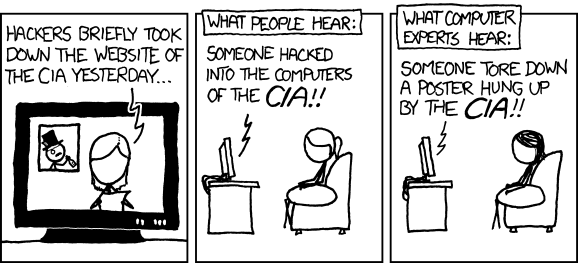
So, recently there was the Black Hat conference in Vegas. For those of you who are less informed, this is basically a large gathering of security researchers presenting their latest findings. And by findings I mean what they have recently broken. Most people dub this a "hacker" conference which is not to unreasonable, but I have one issue with it. The media coverage of it.
The only reason the term "hacker" is used is to sound sexy to the media. They hear that word and they are doing backflips through rings of fire to get the story. And as we are aware the media doesn't always get it right when reporting computer security related issues. Black hat presentations are geared to getting the media attention and causing a bit of a frenzy.
A prime example of that is Don Bailey's presentation which was entitled "War Texting: Identifying and Interacting with Devices on the Telephone Network" which does raise some valid points about connectivity of critical devices (details in another post) but it was also well marketed. He showed that he could unlock cars just by sending a few text messages. When normal people hear something like "vulnerability in FPGA-based control systems" or something similar they do not really know what it means.
Say "I can unlock your car with my phone" and they are scared. Don did say (quote in this article) "I could care less if I could unlock a car door. It's cool. It's sexy. But the same system is used to control phone, power, traffic systems. I think that's the real threat." Which is basically my grievance. As security researchers, we have to sexy up our ideas and then present them to the general populous. Which in turn leads to what I would deem to be an inconvenience.
If you want media attention, then you research on topics that you can sell with a little bit of FUD. Which does restrict your scope quite a lot. This then has a further effect that people view security researchers as only doing this kind of research. This leaves the more theoretical people, like myself, out in the cold, so to speak. Which may or may not be a bad thing, I am not really sure, but I am very sure that it does grind my gears a smidge.
Sunday, 14 August 2011


Wednesday, 27 July 2011
Security the MS way: Protecting you from yourself!
I have always maintained that Microsoft's security policy is essentially to stop you from doing anything stupid. The concept in itself is fairly sound, but the implementation is not. In the classic Operating System debate of Windows versus Linux, the biggest point Linux users make is that they can modify any part of the operating system to suit their needs and desires. When I used Windows XP, I had found all the little secrets to get my machine to do what I wanted it to do. But, I digress.
Microsoft basically adopted the "protect the users from themselves" approach in earnest in Windows Vista. There are several reason why I (and others) am not too fond of Vista, but that aside. The idea is sound in theory, but the implemenatation of it left so much to be desired. In hiding all the knifes from the kids, they also hid all the forks and spoons. Yes, I agree that some of the functionalities should not be available to normal users, but it should be available to admin users.
A whole plethora of useful features were hidden, but we shan't go into that now. The main thing is this article. Now I know I'm a bit late to jump onto this, but I have been a tad lazy. Moving on. So it seems that Hotmail will ban common and quite frankly shit passwords. This is a good and a bad thing.
As I have pointed out before, passwords can be tricky things. For something iek your e-mail account, you need a decent password. So now if Hotmail will reject your password because it's shit, that good right? Well, yes and no. It does stop dictionary attacks, however it drastically changes the search space.
Previously, an attacker would run dictionary attacks in the hope that somebody was a fool. Now that cannot happen then the system is foolproof right? Yes, but to quote Douglas Adams "A common mistake that people make when trying to design something completely foolproof is to underestimate the ingenuity of complete fools." It may sound a touch misanthropic, but people are stupid.
Eventually what is going to happen is that people will find that people will find the least complex passwords that pass through the Hotmail filter and then use those passwords repeatedly. Now dictionary based attacks kick in again, just with a new dictionary. The dictionaries may be larger than previously, but it may not be a significant amount.
So, it is a good idea and I am very much in favour of this, but it could also backfire. Only time will tell, we shall wait and see.
Microsoft basically adopted the "protect the users from themselves" approach in earnest in Windows Vista. There are several reason why I (and others) am not too fond of Vista, but that aside. The idea is sound in theory, but the implemenatation of it left so much to be desired. In hiding all the knifes from the kids, they also hid all the forks and spoons. Yes, I agree that some of the functionalities should not be available to normal users, but it should be available to admin users.
A whole plethora of useful features were hidden, but we shan't go into that now. The main thing is this article. Now I know I'm a bit late to jump onto this, but I have been a tad lazy. Moving on. So it seems that Hotmail will ban common and quite frankly shit passwords. This is a good and a bad thing.
As I have pointed out before, passwords can be tricky things. For something iek your e-mail account, you need a decent password. So now if Hotmail will reject your password because it's shit, that good right? Well, yes and no. It does stop dictionary attacks, however it drastically changes the search space.
Previously, an attacker would run dictionary attacks in the hope that somebody was a fool. Now that cannot happen then the system is foolproof right? Yes, but to quote Douglas Adams "A common mistake that people make when trying to design something completely foolproof is to underestimate the ingenuity of complete fools." It may sound a touch misanthropic, but people are stupid.
Eventually what is going to happen is that people will find that people will find the least complex passwords that pass through the Hotmail filter and then use those passwords repeatedly. Now dictionary based attacks kick in again, just with a new dictionary. The dictionaries may be larger than previously, but it may not be a significant amount.
So, it is a good idea and I am very much in favour of this, but it could also backfire. Only time will tell, we shall wait and see.
Wednesday, 29 June 2011
FIFTY!!! YAAAYY!!!
So, this is my 50th post. WOOHOOO!!! Enough with the celebrations, we have work to do. I decided to mark this momentous milestone, I will discuss the basics of cryptography. Now, I know I have covered some bits of this before, feel free to skip any parts you think you know. So, let's start by naming the three principle components of cryptography : Encryption, Signatures/Message Authentication Codes(MACs) and Proofs.
So, let's start with the first, and probably most well-known, section: Encryption. The scenario is simple, you have a message that you wish to communicate to somebody else, without anybody else finding out that message. The way to do this is encryption. Think back to when you were a kid and you and your friends made up a secret language. That could be viewed as a crude form of encryption, as can all languages. But now, lets talk about the more modern stuff.
An encryption scheme is basically two functions: and encryption function, which I will denote by ENC, and a decryption function, which I will denote by DEC. ENC takes a normal message and turns it into something unintelligible, called a ciphertext. DEC takes a ciphertext and turns it back into the message. To do this, both functions need some additional information, called a key. There are two flavours of encryption, both defined by the relation between the keys used by ENC and DEC. In symmetric or secret key encryption, both ENC and DEC use the same key, whereas in asymmetric or public key encryption, they use distinct but related keys.
Now you must be wondering where all these keys come from and how they get to the right people. For the asymmetric setting it's fairly simple. The receiver generates the keys and publishes the public encryption key, PK, and keeps the decryption key, SK, secret. The publication of PK leads to some very interesting problems, but that's out of scope, but worth mentioning. In the symmetric setting, it's a tad more complicated and this problem is a whole research area on it's own. Let's just say that there are clever ways of doing it in several circumstances.
Now signatures/MACs are essentially the same thing, with different key settings. MAC use symmetric keys and signatures use asymmetric keys. They both serve the same purpose, that is to authenticate the source of a message. For simplicity, I will refer to both of them as codes, which is an abuse of many notations, but will suffice for our purposes. All code systems have two functions: generate, denoted GEN, and verify, denoted VER, and they work as follows: generate takes in a message and outputs a tag and verify takes in a message and a tag and checks if the tag was indeed generated by the sender for that message.
Here we must note two very important things. Tags are both sender and message dependant. Thus a valid tag for one message, cannot be a valid tag for another message sent by the same person. Also, a valid tag for a message sent by one person cannot be a valid tag for the same message sent by another person. Thus the VER functions takes as input the message and the identity of the person, implicitly in the key. The main assumption here is that only the sender can generate a valid tag and thus any valid tag implies that the message was sent by them. This is very close to real world signatures and how we view them. Yes, I know that real signatures can be forged, but we also consider that in cryptography. There are some subtleties as to how this is done, but we shan't venture into that.
Finally, we come upon proofs. These are the least well-known and some would say the least understood of the three. The basic idea behind a proof system is that one party wants to prove to the other that a secret value x has some property. The property could be proven by revealing x, but then that would defeat the point of it being secret. So you need to somehow show that x has this property, but without revealing x. We seem to be in a bit f a pickle. That is, until our hero zero knowledge proofs show. These are protocols which allow you to prove certain statements about a value(s) without revealing the value and without the other person learning anything about the secret value.
A simple way to view this is by the simple statement: "Pick a card, any card!" Let's say I hand you a deck of cards and you pick one out at random and put it aside. Now I ask you what suit it is. You tell me it's a spade. I ask you to prove it. You could show me your card, but that's a secret right? Well, how about you show me 13 clubs, 13 hearts and 13 diamonds. *DING*! Now I know nothing more about your card than that it is in fact a spade. This example is great when explaining not only zero knowledge proofs, but also some of it's stranger variants. But that's all for later (read: maybe if I feel like, but don't hold your breath).
So, all in all, we covered the three basic concepts in cryptography because I'm too lazy to do real posts and the number 50 was just mainly an excuse. We hope to have a resumption of normal service soon-ish.
So, let's start with the first, and probably most well-known, section: Encryption. The scenario is simple, you have a message that you wish to communicate to somebody else, without anybody else finding out that message. The way to do this is encryption. Think back to when you were a kid and you and your friends made up a secret language. That could be viewed as a crude form of encryption, as can all languages. But now, lets talk about the more modern stuff.
An encryption scheme is basically two functions: and encryption function, which I will denote by ENC, and a decryption function, which I will denote by DEC. ENC takes a normal message and turns it into something unintelligible, called a ciphertext. DEC takes a ciphertext and turns it back into the message. To do this, both functions need some additional information, called a key. There are two flavours of encryption, both defined by the relation between the keys used by ENC and DEC. In symmetric or secret key encryption, both ENC and DEC use the same key, whereas in asymmetric or public key encryption, they use distinct but related keys.
Now you must be wondering where all these keys come from and how they get to the right people. For the asymmetric setting it's fairly simple. The receiver generates the keys and publishes the public encryption key, PK, and keeps the decryption key, SK, secret. The publication of PK leads to some very interesting problems, but that's out of scope, but worth mentioning. In the symmetric setting, it's a tad more complicated and this problem is a whole research area on it's own. Let's just say that there are clever ways of doing it in several circumstances.
Now signatures/MACs are essentially the same thing, with different key settings. MAC use symmetric keys and signatures use asymmetric keys. They both serve the same purpose, that is to authenticate the source of a message. For simplicity, I will refer to both of them as codes, which is an abuse of many notations, but will suffice for our purposes. All code systems have two functions: generate, denoted GEN, and verify, denoted VER, and they work as follows: generate takes in a message and outputs a tag and verify takes in a message and a tag and checks if the tag was indeed generated by the sender for that message.
Here we must note two very important things. Tags are both sender and message dependant. Thus a valid tag for one message, cannot be a valid tag for another message sent by the same person. Also, a valid tag for a message sent by one person cannot be a valid tag for the same message sent by another person. Thus the VER functions takes as input the message and the identity of the person, implicitly in the key. The main assumption here is that only the sender can generate a valid tag and thus any valid tag implies that the message was sent by them. This is very close to real world signatures and how we view them. Yes, I know that real signatures can be forged, but we also consider that in cryptography. There are some subtleties as to how this is done, but we shan't venture into that.
Finally, we come upon proofs. These are the least well-known and some would say the least understood of the three. The basic idea behind a proof system is that one party wants to prove to the other that a secret value x has some property. The property could be proven by revealing x, but then that would defeat the point of it being secret. So you need to somehow show that x has this property, but without revealing x. We seem to be in a bit f a pickle. That is, until our hero zero knowledge proofs show. These are protocols which allow you to prove certain statements about a value(s) without revealing the value and without the other person learning anything about the secret value.
A simple way to view this is by the simple statement: "Pick a card, any card!" Let's say I hand you a deck of cards and you pick one out at random and put it aside. Now I ask you what suit it is. You tell me it's a spade. I ask you to prove it. You could show me your card, but that's a secret right? Well, how about you show me 13 clubs, 13 hearts and 13 diamonds. *DING*! Now I know nothing more about your card than that it is in fact a spade. This example is great when explaining not only zero knowledge proofs, but also some of it's stranger variants. But that's all for later (read: maybe if I feel like, but don't hold your breath).
So, all in all, we covered the three basic concepts in cryptography because I'm too lazy to do real posts and the number 50 was just mainly an excuse. We hope to have a resumption of normal service soon-ish.
Saturday, 25 June 2011
Why is digital money may be a bad idea.
Basically right after I posted this, I read this. Kind of an "I told you so" moment. But apart from that I am at a lack of words for this. I've been staring at my screen for a couple of days now and I have nothing (useful or insightful) to write. Apart from the fact that this whole real currency-bitcoin exchange is a little bit hinky and this is one of the problems you can have with it. For this post, please insert the accustomed amount of wit, cynicism and all that jazz you are used to. Thanks :)

Monday, 20 June 2011
Let's talk money, digital money!
Alrighty then, I'm going to assume that everybody has some basic understanding of the concept of money. Next, I assume you all have some idea of how to spend money online using things like paypal, credit cards, debit cards and so forth. Also, the reason nobody that people shouldn't be able to steal your details and thus your money, if it's all done right, depends heavily on crypto. Best way to explain what I do, is to ask "Have you ever bought anything online?" When they answer in the affirmative, then I say "You're welcome."
All levity aside, let's talk about money. Money is official looking paper and bits of metal that carry some value. This value is backed by some central authority. This would normally be the central bank of the country, but could be larger such as the Eurozone. There's a whole lot of economics behind how and why this works, inflation, deflation, devaluation, exchange rates etc that I don't even pretend to understand. We all accept this at face value and move with our lives.
In the online world, it's basically the same thing. The authorities may have changed to credit card issuers, certification authorities and others, but the principle remains the same. Now, this idea doesn't sit too well with the über-privacy people. They are now afraid of all the digital "paper trail", if you will, that is created by all of this. They say that if we can use crypto to secure our transactions, then why not use it to preserve our privacy and create anonymity.
Well, there is quite a lot of cryptographic research in the field of what we like to call e-cash. All this research is completely agnostic of the economic aspects and focuses on the crypto stuff. Until a few days ago, I thought there was no real implementation of any sort of e-cash. Then I heard about Bitcoin. Just as a brief side-note, cryptographers love coins. It's some what of a convention that all randomness is generated using coins and that all e-cash schemes are described in terms of coins. There is good reasoning behind it, but I shan't go into details.
So, back to Bitcoin, which is "the first decentralised digital currency" according to the introductory video. They then go on to explain how it all works and what the advantages are. I'll just recap it for you, for completeness. Bitcoins works using identifiers called addresses, which are essentially random strings. Each user gets 1 when they download the client software. They can then create more so as to have different types of payments come and/or go to/from different addresses. All of these are tied to the same wallet. So if person has addresses a and b then sending money to either address would be the same. This is how anonymity is preserved.
When Bitcoins are sent from person to person, the transaction is hashed and signed. The hash value and digital signature are then verified by the the other users in the system. Once a transaction is verified, the Bitcoins are added to and subtracted from the relevant accounts. This is the decentralised aspect. In normal e-commerce transactions, the verification would be done by a centralised authority such as a bank or clearing house. With Bitcoins this is done in a peer-to-peer (P2P) manner. Another interesting thing is that Bitcoins are super divisible. You can go down to 0.00000001BTC. Which is the advantage of having a digital currency.
So I thought I'll give this a try. So, I downloaded the client software and started reading through the literature and all the wikis and got a feeling for how this all works. There is a whole sub-culture built based around bitcoins and it is quite fascinating. There are entire forums and IRC channels dedicated to the provision of trade in and using Bitcoins. However, as I dug deeper I discovered two very interesting points.
Firstly, Bitcoins are more of a commodity than a currency IMHO. I would like to think of Bitcoins as digital gold. This analogy is fairly apt given the way the currency works, especially with respect to generation. The generation of Bitcoins is called "mining" and involves essentially finding a pre-image for a hash function. Now this requires huge amounts of computations, but once done, a "block" is created. The creation of this block gives the creator some Bitcoins, at time of writing this stands at 50BTC. For those of us that do not have a super computer, there are still options.
The basic technique is called "pooled mining." Here what you do is you combine your computational power and split up the profits according to how much work you did. One way of doing this, if you have a reasonable large amount of computational power, is to join a mining pool. There are several ways this can be done and there are a few technical details that need to considered. Mostly these depend on a central server, which is ironically what Bitcoin was trying to avoid. For those of us with less computational power, there are alternatives, such as this (BTW if you are feeling really nice, you could try and generate a few coins for me here or you could just send some to 1KbnDDaS3UTAMZkqHSJwGuWgdApQr3wAqp).
However, there are other ways. Carrying on the gold analogy, there are people who own gold but have never even been near a mine. How? They buy it! The same goes for Bitcoins. There are some marketplaces where you can buy and sell Bitcoins for real money. It's fairly easy to compare to say a fresh fish market, let's say. Basically, the fishermen catch the fish (in this case they mine Bitcoins) and then go to a fixed place to sell it. The public knows this place and come there to buy some fish (or in our case Bitcoins). The reason I use the fish market analogy is that there is some haggling and negotiations involved, which is not unlike the Bitcoin marketplaces. In this places you can buy and/or sell Bitcoins for USD, GBP, EUR, or even SLL, the currency of Second Life. Not kidding on the last one.
Which sort of brings me to the second point. Even though Bitcoin is supposed to be decentralised, it seems to be doing it's best to achieve the exact opposite. The whole idea is to not trust this one monolithic central institution, but instead distribute the trust amongst all participants in the system, that is using P2P. There is always some sort of large trust placed in central entities, of varying size, but the point still remains. Transaction verification is still very much P2P, but not much else is. And therein lie the problems.
"With great power comes great responsibility" said Uncle Ben, rightly so. In the mining context, there are ways that servers and miners can cheat. The details of this are fairly technical and thus I will skip them. The essence is that if you control a large enough share of the mining pool, you can control the outcome of the pool, in that who receives how much money. Some people would argue that such attacks are infeasible, but I think they are possible. Further more, with all the multiple currency exchanges, it's not unlikely that somebody could be making, or trying to make, money speculating of price rises and drops. The problem here is that because it's so decentralised, there is the risk of somebody "making a run on the currency." I'm not entirely sure I know how that works, but I believe them.
The most recent problem that has surfaced is that of theft. All the "money" is stored locally on your hard drive in a single file called "wallet.dat". After reading a few of the forums, it became painfully obvious that everybody knows exactly what this file is and what it does. I thought to myself "That's quite a nice target for an attack". Hey presto, somebody did it. The thing with attacks of this kind is that they are pretty much untraceable. Remember, Bitcoin operates on anonymous identities, so even if you get the address that the money was sent to, you don't really learn anything.
So, there are some really cool things about Bitcoin and some not so cool things. I really have no strong opinions about it either way at this point in time. I am just going to let things develop and see what happens. There is a lot of talk about how these may be used to buy and sell drugs, which could lead to the whole thing being shut down, but we shall have to wait and see.
All levity aside, let's talk about money. Money is official looking paper and bits of metal that carry some value. This value is backed by some central authority. This would normally be the central bank of the country, but could be larger such as the Eurozone. There's a whole lot of economics behind how and why this works, inflation, deflation, devaluation, exchange rates etc that I don't even pretend to understand. We all accept this at face value and move with our lives.
In the online world, it's basically the same thing. The authorities may have changed to credit card issuers, certification authorities and others, but the principle remains the same. Now, this idea doesn't sit too well with the über-privacy people. They are now afraid of all the digital "paper trail", if you will, that is created by all of this. They say that if we can use crypto to secure our transactions, then why not use it to preserve our privacy and create anonymity.
Well, there is quite a lot of cryptographic research in the field of what we like to call e-cash. All this research is completely agnostic of the economic aspects and focuses on the crypto stuff. Until a few days ago, I thought there was no real implementation of any sort of e-cash. Then I heard about Bitcoin. Just as a brief side-note, cryptographers love coins. It's some what of a convention that all randomness is generated using coins and that all e-cash schemes are described in terms of coins. There is good reasoning behind it, but I shan't go into details.
So, back to Bitcoin, which is "the first decentralised digital currency" according to the introductory video. They then go on to explain how it all works and what the advantages are. I'll just recap it for you, for completeness. Bitcoins works using identifiers called addresses, which are essentially random strings. Each user gets 1 when they download the client software. They can then create more so as to have different types of payments come and/or go to/from different addresses. All of these are tied to the same wallet. So if person has addresses a and b then sending money to either address would be the same. This is how anonymity is preserved.
When Bitcoins are sent from person to person, the transaction is hashed and signed. The hash value and digital signature are then verified by the the other users in the system. Once a transaction is verified, the Bitcoins are added to and subtracted from the relevant accounts. This is the decentralised aspect. In normal e-commerce transactions, the verification would be done by a centralised authority such as a bank or clearing house. With Bitcoins this is done in a peer-to-peer (P2P) manner. Another interesting thing is that Bitcoins are super divisible. You can go down to 0.00000001BTC. Which is the advantage of having a digital currency.
So I thought I'll give this a try. So, I downloaded the client software and started reading through the literature and all the wikis and got a feeling for how this all works. There is a whole sub-culture built based around bitcoins and it is quite fascinating. There are entire forums and IRC channels dedicated to the provision of trade in and using Bitcoins. However, as I dug deeper I discovered two very interesting points.
Firstly, Bitcoins are more of a commodity than a currency IMHO. I would like to think of Bitcoins as digital gold. This analogy is fairly apt given the way the currency works, especially with respect to generation. The generation of Bitcoins is called "mining" and involves essentially finding a pre-image for a hash function. Now this requires huge amounts of computations, but once done, a "block" is created. The creation of this block gives the creator some Bitcoins, at time of writing this stands at 50BTC. For those of us that do not have a super computer, there are still options.
The basic technique is called "pooled mining." Here what you do is you combine your computational power and split up the profits according to how much work you did. One way of doing this, if you have a reasonable large amount of computational power, is to join a mining pool. There are several ways this can be done and there are a few technical details that need to considered. Mostly these depend on a central server, which is ironically what Bitcoin was trying to avoid. For those of us with less computational power, there are alternatives, such as this (BTW if you are feeling really nice, you could try and generate a few coins for me here or you could just send some to 1KbnDDaS3UTAMZkqHSJwGuWgdApQr3wAqp).
However, there are other ways. Carrying on the gold analogy, there are people who own gold but have never even been near a mine. How? They buy it! The same goes for Bitcoins. There are some marketplaces where you can buy and sell Bitcoins for real money. It's fairly easy to compare to say a fresh fish market, let's say. Basically, the fishermen catch the fish (in this case they mine Bitcoins) and then go to a fixed place to sell it. The public knows this place and come there to buy some fish (or in our case Bitcoins). The reason I use the fish market analogy is that there is some haggling and negotiations involved, which is not unlike the Bitcoin marketplaces. In this places you can buy and/or sell Bitcoins for USD, GBP, EUR, or even SLL, the currency of Second Life. Not kidding on the last one.
Which sort of brings me to the second point. Even though Bitcoin is supposed to be decentralised, it seems to be doing it's best to achieve the exact opposite. The whole idea is to not trust this one monolithic central institution, but instead distribute the trust amongst all participants in the system, that is using P2P. There is always some sort of large trust placed in central entities, of varying size, but the point still remains. Transaction verification is still very much P2P, but not much else is. And therein lie the problems.
"With great power comes great responsibility" said Uncle Ben, rightly so. In the mining context, there are ways that servers and miners can cheat. The details of this are fairly technical and thus I will skip them. The essence is that if you control a large enough share of the mining pool, you can control the outcome of the pool, in that who receives how much money. Some people would argue that such attacks are infeasible, but I think they are possible. Further more, with all the multiple currency exchanges, it's not unlikely that somebody could be making, or trying to make, money speculating of price rises and drops. The problem here is that because it's so decentralised, there is the risk of somebody "making a run on the currency." I'm not entirely sure I know how that works, but I believe them.
The most recent problem that has surfaced is that of theft. All the "money" is stored locally on your hard drive in a single file called "wallet.dat". After reading a few of the forums, it became painfully obvious that everybody knows exactly what this file is and what it does. I thought to myself "That's quite a nice target for an attack". Hey presto, somebody did it. The thing with attacks of this kind is that they are pretty much untraceable. Remember, Bitcoin operates on anonymous identities, so even if you get the address that the money was sent to, you don't really learn anything.
So, there are some really cool things about Bitcoin and some not so cool things. I really have no strong opinions about it either way at this point in time. I am just going to let things develop and see what happens. There is a lot of talk about how these may be used to buy and sell drugs, which could lead to the whole thing being shut down, but we shall have to wait and see.
Monday, 13 June 2011
Something that has been bugging me for a while
Do you have a facebook account? Rhetorical question, of course you do. If you don't well then you can leave now because this post is all about *drumroll* FACEBOOK! Seeing as how it is on my blog, one can safely assume that it is about facebook security. So, what have facebook done now? They are protecting your from them.
Confused? So was I. Basically they have started up this new scheme to prevent Cross-Site Scripting(XSS) and Clickjacking and other scripting based vulnerabilities. Some of you may be unfamiliar with scripting and the vulnerabilities therein. Most modern webpages serve up dynamic content, making the experience different for each user. A good example of this is your facebook newsfeed, which is different from your friend's feed.
This is all achieved using scripting. A script is essentially some sort of program code that runs within your web-browser. The catch is, you never explicitly execute the scripts like you do programs. They are embedded in the webpage and are executed when you open the webpage, or at some other suitable trigger. The problem then is that people could embed malicious scripts into pages and you will not realise they have run, until it's too late.
I'm sure you've all had that one friend who has posted the same spam link to everybody and 10mins later warned you not to click it. That is basically what these malicious scripts do. So, facebook decided that they need to address the issue, which they did pathetically.
What they have done is now they "read" your URLs and check it for any script. Again, ANY script. That means that if any script is detected, you will be logged out of facebook instantly as a security precaution. You may wonder why this is a problem. Well, as eluded to earlier, almost all actions on facebook are scripts. See more items in your news feed, liking a post, commenting on a post, writing on somebody's wall, the chat feature. Everything is a script. So now, facebook sees you trying to do something legitimate and decides to kick you out. It doesn't always happen, but it's often enough to be mildly aggravating.
It's bad enough that you have to re-login, but what's even worse is that you go through the following twp screens: (full size images here and here)
 and then a 3rd asking if you would like to share a link explaining how great facebook security is. Honestly, I would rather have a red-hot iron bar slapped onto my arm. This is because if you read the messages carefully, you will notice a couple of "< br >" tags popping up.
This is not a security issue, but it does mean that whom so ever wrote those pages is probably a moron! "< br >" was/is the tag used in HTML to induce a line break. However, newer standards such as XHTML and HTML5 insist on using "< br />" for technical reasons. Believe me, it's a good idea. So, this lead me to the conclusion that most facebook web developers have written sloppy HTML/PHP/JScript/Whatever else they use and that is causing the "safety filter" to go off at least twice a week on my account. Also, I'm not sure how good the code for the "filter" is. I have very low expectations.
The first time I was logged out by this "filter", I was impressed that facebook had implemented such a feature. I guess that they had some bugs in it, which was understandable. With each subsequent occurrence of me being "filtered out", I grew more sceptical. Then when I saw the horrendous HTML code in the warnings, I gave up hope and waited for it to happen again to make screen shots.
I didn't have to wait too long. Most people would say "Well at least they tried!" To which I reply, "Welcome to cyber-security, where a half-assed attempt doesn't count!" Really, facebook, get your act together and actually make an attempt and then maybe I'll be impressed and stop writing evil comments on the your security fan pages.
Confused? So was I. Basically they have started up this new scheme to prevent Cross-Site Scripting(XSS) and Clickjacking and other scripting based vulnerabilities. Some of you may be unfamiliar with scripting and the vulnerabilities therein. Most modern webpages serve up dynamic content, making the experience different for each user. A good example of this is your facebook newsfeed, which is different from your friend's feed.
This is all achieved using scripting. A script is essentially some sort of program code that runs within your web-browser. The catch is, you never explicitly execute the scripts like you do programs. They are embedded in the webpage and are executed when you open the webpage, or at some other suitable trigger. The problem then is that people could embed malicious scripts into pages and you will not realise they have run, until it's too late.
I'm sure you've all had that one friend who has posted the same spam link to everybody and 10mins later warned you not to click it. That is basically what these malicious scripts do. So, facebook decided that they need to address the issue, which they did pathetically.
What they have done is now they "read" your URLs and check it for any script. Again, ANY script. That means that if any script is detected, you will be logged out of facebook instantly as a security precaution. You may wonder why this is a problem. Well, as eluded to earlier, almost all actions on facebook are scripts. See more items in your news feed, liking a post, commenting on a post, writing on somebody's wall, the chat feature. Everything is a script. So now, facebook sees you trying to do something legitimate and decides to kick you out. It doesn't always happen, but it's often enough to be mildly aggravating.
It's bad enough that you have to re-login, but what's even worse is that you go through the following twp screens: (full size images here and here)
and then a 3rd asking if you would like to share a link explaining how great facebook security is. Honestly, I would rather have a red-hot iron bar slapped onto my arm. This is because if you read the messages carefully, you will notice a couple of "< br >" tags popping up.This is not a security issue, but it does mean that whom so ever wrote those pages is probably a moron! "< br >" was/is the tag used in HTML to induce a line break. However, newer standards such as XHTML and HTML5 insist on using "< br />" for technical reasons. Believe me, it's a good idea. So, this lead me to the conclusion that most facebook web developers have written sloppy HTML/PHP/JScript/Whatever else they use and that is causing the "safety filter" to go off at least twice a week on my account. Also, I'm not sure how good the code for the "filter" is. I have very low expectations.
The first time I was logged out by this "filter", I was impressed that facebook had implemented such a feature. I guess that they had some bugs in it, which was understandable. With each subsequent occurrence of me being "filtered out", I grew more sceptical. Then when I saw the horrendous HTML code in the warnings, I gave up hope and waited for it to happen again to make screen shots.
I didn't have to wait too long. Most people would say "Well at least they tried!" To which I reply, "Welcome to cyber-security, where a half-assed attempt doesn't count!" Really, facebook, get your act together and actually make an attempt and then maybe I'll be impressed and stop writing evil comments on the your security fan pages.
Sunday, 12 June 2011
Quick post on how I may be kind of wrong.
If you know me at all, you will know that I have strong opinions on some things. If you don't know me, you now know that I have strong opinions on certain things. Now that everybody is caught up, let's all sit back and enjoy me being wrong-ish. I had a post earlier, which really is based on the fact that access to the Internet is a privilege, that some people abuse. Well now the United Nations has declared it a human right. My argument falls flat on it's face. I'm a big boy and I am willing to admit that in light of this, those arguments no longer hold water. Things change, people's ideas are made to be wrong, that's life.
Also, just a minor side-note: read this article!
Also, just a minor side-note: read this article!
Subscribe to:
Posts (Atom)
Subscribe To







 Posts
All Comments
Posts
All Comments